We use audience-measurement cookies (Google Analytics) to understand how the site is used. They are only set with your consent. Learn more
1 September 2026
How to Design a Welcoming Entrance in Antibes
The entrance is the room you cross ten times a day without ever really looking at it. In Antibes it takes the salt, the sand and the coats as soon as the first cool mornings arrive. We treat it as a proper room all the same, with its own light, its own materials and storage measured to the centimetre. Here is how we work when a family asks us to rethink that first threshold.
What the entrance says before any other room
Nobody ever sits down in an entrance hall. It still sends the first signal, the one your guests register in three seconds without thinking about it. A crowded entrance announces a crowded house, even when the living room behind it is kept perfectly. A calm entrance prepares the eye for everything that follows.
In Antibes the problem is rarely taste. It is volume. In the old town and up towards La Constance the entrances are narrow, sometimes open on both sides, often without a window. In the villas built in the seventies near the Cap it is the opposite: a large glazed porch, very bright, that nobody knows how to furnish and that ends up as a dumping zone.
So our first question is never about style. We ask how many people come through that door each day, what they carry in their hands, and where the shoes end up right now. The answer already draws half the project. A family with three children and two dogs does not need the same entrance as a couple who entertain on Saturday evenings.
We then measure the real circulation, not the theoretical one. An entrance stays pleasant as long as seventy centimetres of clear passage remain once the furniture is in place. Below that, people brush past each other and catch their sleeves, and the handsome piece of furniture becomes an obstacle everyone resents within a month.
Catching the Antibes light at the threshold
The light here has a particular quality in September and October. It is still sharp around midday, it tips quickly towards gold at the end of the day, and it often arrives at an angle, bounced off a pale facade or off the sea. A well planned entrance catches it instead of blocking it.
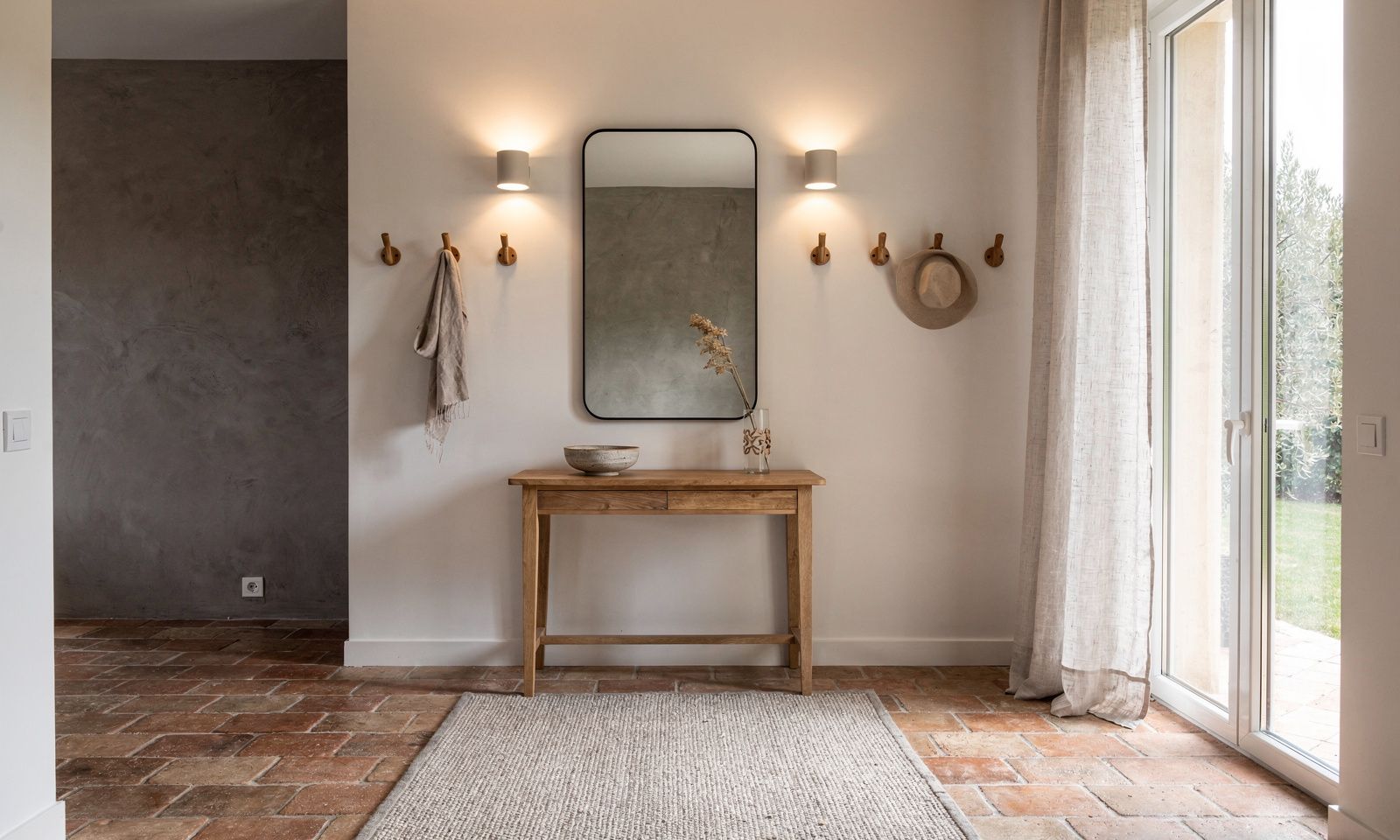
Where a glazed door already exists, we avoid covering it with a heavy curtain. A washed linen sheer, hung high on a slim rod, lets the daylight through while cutting the view from the street. The fabric should be slightly longer than strictly needed so it hangs straight and absorbs a little sound, which matters a great deal in a hard, tiled room.
In windowless entrances we work by reflection instead. A wall painted in a warm white with a faint pink undertone bounces artificial light far better than a pure white, which turns grey the moment the sun drops. A wall light aimed at the ceiling, rather than a single central fitting, widens the room visually and removes the hotel corridor effect.
We also keep one simple rule about colour temperature. An entrance stays welcoming around two thousand seven hundred kelvin and never above three thousand. Higher than that, skin looks dull in the mirror and the whole room takes on the air of a municipal lobby, which is not what anyone wants when coming home.
Frequently asked
What we get asked on this.
How deep should furniture be in a narrow entrance?
Between twenty-five and thirty-five centimetres in most cases. Beyond that the clear passage drops below seventy centimetres and the entrance becomes uncomfortable. A shallow console combined with hooks does the same job as a bulky unit without closing the room in.
Which floor copes best with sand and salt in Antibes?
Oiled terracotta tiles and cement tiles protected with a colourless water repellent both hold up very well, provided they are maintained once a year. We avoid glossy finishes, which craze over time and trap dust in the hairline cracks.
Can a small entrance be painted in a dark colour?
Yes, on a single wall, preferably the one you see as the door opens. A muted olive or a greyed terracotta adds depth while the other walls stay in warm white. Four dark walls close a small volume in and become tiring quickly.
Where should the mirror go in a corridor entrance?
On the wall perpendicular to the door rather than opposite it. There it catches the side light and visually doubles the width. A tall format hung at real face height works better than a small decorative mirror placed too high.
What light temperature suits an entrance?
Around two thousand seven hundred kelvin, never above three thousand. Cooler light makes skin look dull in the mirror and recalls a municipal lobby. A wall light aimed at the ceiling works better than a single central fitting.
Which plants survive an entrance with no window?
Zamioculcas and aspidistra both tolerate low light very well and last for years. A potted olive tree, often chosen for the Mediterranean mood, fades within a few months in a dark room and makes the whole space look sad.
Is bespoke joinery worth it in an irregular entrance?
Often yes. As soon as there is a dead corner or a dropped ceiling, a run drawn and then built by a local cabinetmaker costs barely more than a good off-the-shelf piece and recovers volume nothing else can use. We draw it, we price it and we follow the making.
This is the point that people underestimate on the coast. Between the Salis beach, the port and the gravel paths, an Antibes entrance receives sand almost all year, then salt water and mud once the autumn rain arrives. The floor has to take that without turning ugly after two seasons.
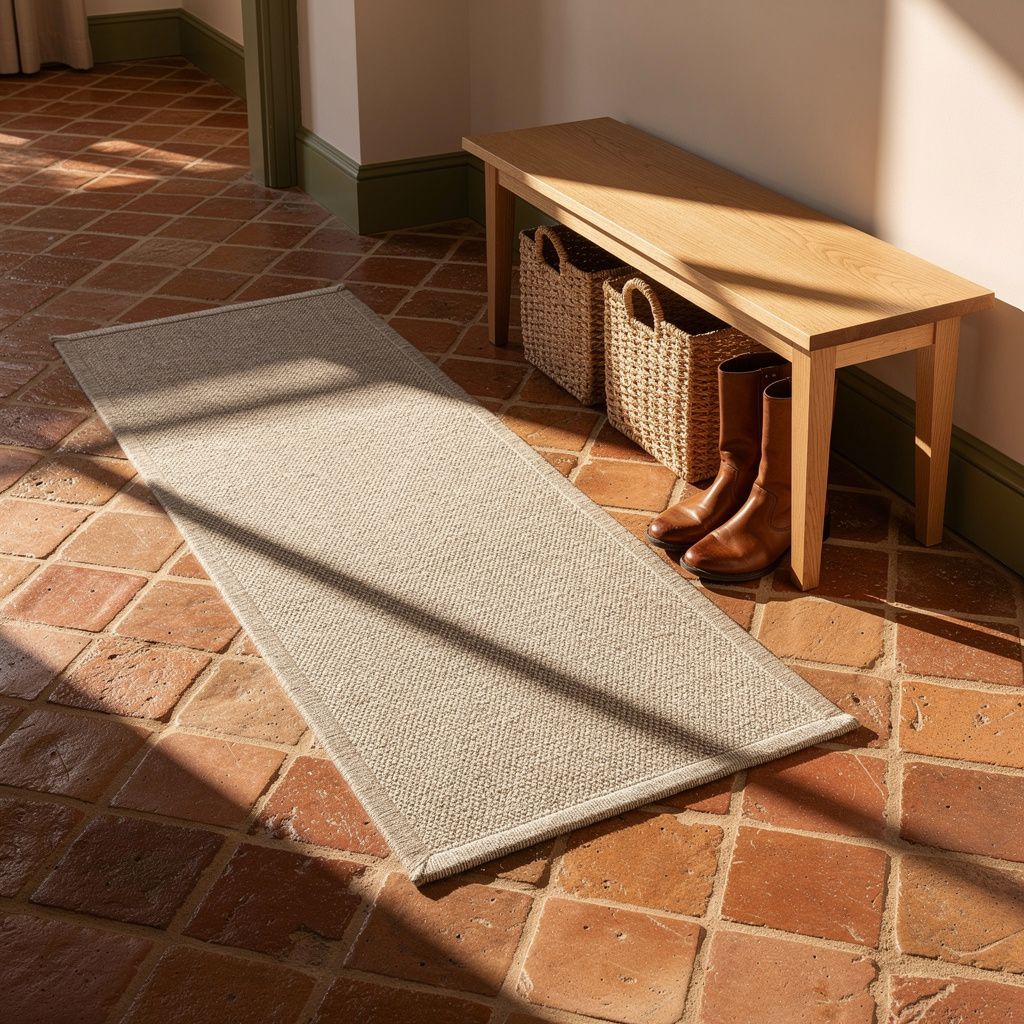
Old terracotta tiles behave very well provided they are fed. A matt finishing oil, reapplied once a year, keeps the depth of colour and prevents the white bloom that salt leaves behind. We advise against glossy sealants, which craze over time and trap dust in the hairline cracks.
On cement tiles, common in the town centre buildings, the question is protection before any heavy use. A colourless water repellent treatment, applied properly, completely changes the working life of the floor. Without it, every drop of salt water leaves a pale mark and the household slowly draws its own route across the room.
We almost always add a runner, though not just any runner. Pure jute holds the sand and warps with humidity. We prefer a short pile wool and jute blend, or a flat washable weave, laid over a thin non-slip underlay. A rug of one hundred and eighty by eighty centimetres covers the real path of people's feet, while a small decorative mat only decorates.
Right-sized storage, neither too much nor too little
The most common mistake is to install an enormous closed unit that eats the room, then fill it with things that have no business being there. The second mistake is to plan nothing at all and let the coats live on a chair. The right volume sits between the two and can be calculated.
We start from the number of coats actually worn at the same time. Four people means four useful hooks, plus two for visitors, not twelve. For shoes we count two pairs per person within easy reach, and the rest goes back to the bedrooms. An entrance is not a store room, it is a transition zone.
A shallow console, between twenty-five and thirty-five centimetres deep, is nearly always enough and keeps the passage clear. We like to pair it with a bench, which settles a very practical question: where do you sit to pull off boots in November. Two natural fibre baskets under the bench absorb daily clutter without reading as a storage unit.
Bespoke joinery earns its cost in awkward entrances, the ones with a dead corner or a dropped ceiling. A local cabinetmaker builds a run that follows the wall exactly, in pale oak or matt paint, often for a budget close to a good off-the-shelf piece. We draw it, we price it, and the Emicasa Interiors atelier follows the making through to installation.
Autumn 2026 colours in a small volume
The coming season pushes earthy tones: soft brick, muted mustard, olive green, caramel brown. Those colours work well in an entrance as long as they are not applied everywhere. In a small volume, a strong shade on four walls closes the room in and becomes tiring within weeks.
We prefer the single wall rule, on the wall you see as the door opens. Painted in a muted olive or a greyed terracotta, it gives depth at the far end while the other three walls stay in warm white. The effect is immediate and it stays reversible, which counts when you are hesitating.
Another approach is to paint the joinery rather than the walls. A front door treated on the inside in a warm brown, with pale walls around it, produces an elegant contrast without reducing the perceived space. Skirting boards painted in the same shade tie the room together and visually rescue a slightly dated floor.
For the final choice we always put up large samples, A3 format at the very least, and look at them at three moments of the day. A shade approved under a ceiling light at nine in the evening often behaves quite differently the next morning with daylight coming through the door.
Mirror, hooks and the sense of space
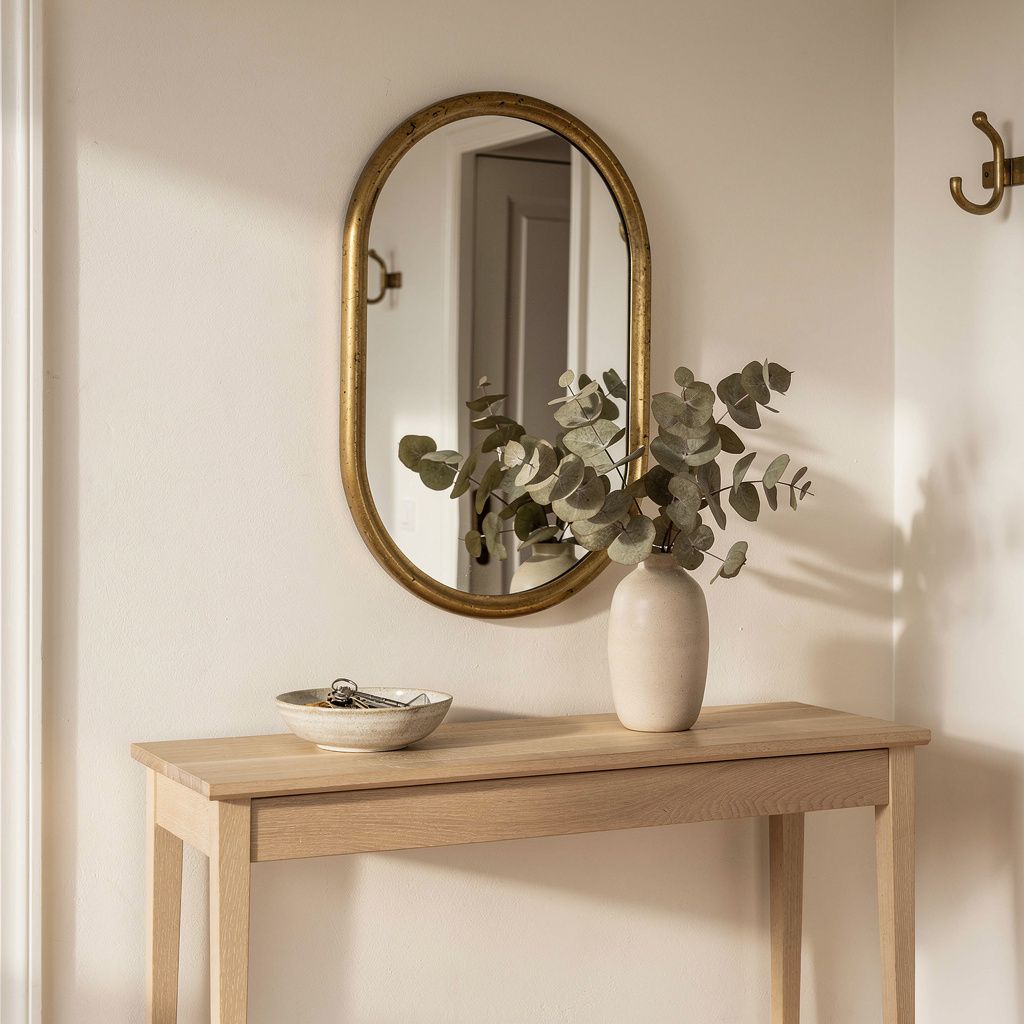
The mirror remains the most effective tool in a narrow entrance, provided it is placed correctly. Facing the door, it reflects the door, which adds nothing. On the perpendicular wall it catches the side light and visually doubles the width, which changes everything in a corridor of a hundred and twenty centimetres.
We choose generous formats, often a tall oval or rectangle hung low, at real face height. A frame in pale wood or aged brass warms the room, while a very thin black frame gives a useful graphic line in the more contemporary seafront interiors.
Hooks deserve the same attention as everything else. Set at around one hundred and seventy centimetres for adults, with a lower row near one hundred and ten centimetres for children, they prevent the pile of jackets on the bench. In brass, turned wood or glazed ceramic they become a pleasant detail rather than a grudging accessory.
Finally we add one catch-all dish, only one, in one precise spot. A Vallauris ceramic bowl, a small wicker basket, a marble tray: the shape hardly matters as long as the family knows where the keys go. Multiplying the receptacles simply multiplies the places to search.
Materials that soften the crossing
An entrance sounds hollow because it gathers all the hard surfaces of the house: tiles, bare walls, a solid door. Comfort therefore comes mostly from the materials you add. Washed linen, bouclé wool, natural rattan and matt ceramic correct that hardness without crowding the passage.
We like to introduce one vertical texture, often a small linen hanging or a woven fibre pendant, which breaks the line of the wall and absorbs part of the echo. One piece is enough. Two start to load the room, three turn the entrance into a shop.
Plants work, provided you are honest about the available light. In a dark entrance a zamioculcas or an aspidistra last for years, while a potted olive tree fades within three months and makes the room look sad. In a very bright porch towards the Cap, a ficus lyrata or a lemon tree in a container are genuinely happy.
Scent matters more than people expect in this room. A candle at the end of the day, a bunch of dried eucalyptus or simply a good soap beside a tap leaves a lasting impression. It is the memory guests keep most faithfully, long after they have forgotten the colour of the wall.
Where to start and in which order
When the budget is limited, the order matters as much as the choices. We always begin with light, because it transforms the perception of everything else for a modest cost. One well placed wall light and a bulb at the right temperature change an entrance in a single evening.
The floor comes next, not necessarily to replace it but to bring it back into condition and lay the right rug. A clean, protected floor carries simple furniture, while a tired floor devalues even a beautiful console. Storage arrives third, once the real needs have been counted.
Paint closes the sequence, because it is decided better once the furniture and rugs are in place. Many families reverse that order, paint first, then find themselves with a shade that clashes with the rug bought afterwards. We prefer to postpone that decision by a few weeks.
If you are starting this autumn, keep one useful constraint in mind: your entrance has to stay pleasant on a Tuesday evening in November, in the rain, with shopping bags in both hands. A room that holds up in those conditions will hold up easily for the rest of the year. We are happy to talk it through over a plan and a few samples.
Designing a Welcoming Entrance in Antibes — Emicasa Interiors